Adaptive Glycan Remodeling in Cancer Progression
Dr. Amulya Sreekumar
GLYCAN BIOSYNTHESIS IN BREAST CANCER: AN ADAPTIVE RESPONSE TO THERAPY AND METASTASIS
Breast cancer remains the leading cause of cancer-related deaths in women worldwide. Mortality is primarily attributable to incurable metastatic recurrences seeded by residual tumor cells (RTCs) that survive first-line therapy, often in a dormant state. Though RTCs comprise as little as 0.01% of the initial tumor mass, they represent the fittest cells capable of surviving therapy and inhospitable metastatic microenvironments. The mechanisms underlying RTC persistence following therapy remain unclear, limiting clinical strategies targeting minimal residual disease (MRD).
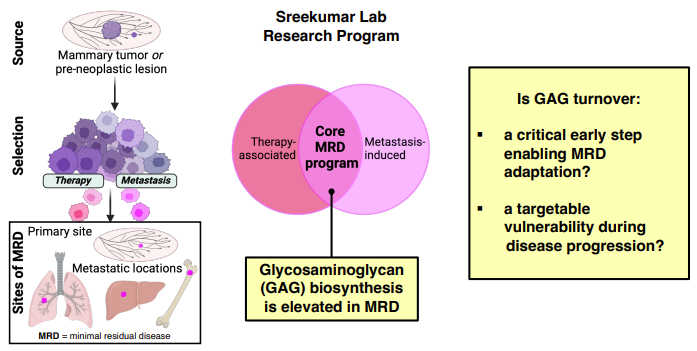
Our previous work has demonstrated that a subset of glycans, namely glycosaminoglycans (GAGs), are selectively enriched following therapy and are central regulators of dormant MRD adaptation to therapy (Sreekumar A, et al., Cancer Cell, 2024). Furthermore, this elevated expression of GAG biosynthetic enzymes is also observed in other MRD contexts, including circulating tumor cells and micrometastases, suggesting that GAG biosynthesis may constitute a common, generalizable mechanism of RTC adaptation.
Strikingly, this glycan dependency uncovered in breast cancer paralleled molecular features associated with rare inherited skeletal disorders. This observation led to the discovery that breast cancer RTCs hijack a bone developmental program, termed endochondral ossification, to maintain dormancy (Sreekumar A, et al., Cancer Discovery, 2026). Together, these studies position glycans as central regulators of therapy adaptation in breast cancer and identify new therapeutic vulnerabilities to prevent recurrence.
Our translationally focused research program investigates how glycan biosynthesis promotes breast cancer therapy resistance and metastasis, asks whether these programs are conserved in patient samples post-therapy, and evaluates the feasibility of targeting glycan remodeling as an approach to prevent disease recurrence. We believe that the exciting and untapped area of glycobiology holds great promise for discoveries with the potential to improve long-term outcomes for breast cancer patients.
Future projects and goals
The overall objective of our research program is to determine whether glycan biosynthesis is an early step in enabling RTC adaptation and a selective vulnerability during cancer progression that can be targeted to prevent recurrence. Using complex disease modeling, together with functional genomics, single-cell approaches, and biochemical tools to characterize GAGs, our research will address the following biological questions:
Project 1: Do GAGs promote MRD activation of endochondral ossification?
Project 2: How do GAGs regulate the MRD-recurrence continuum?
Project 3: How do GAGs synthesized by MRD regulate the innate immune system?

Dr. Amulya Sreekumar
Young Investigator Group Leader – partner site Berlin
Charité – Universitätsmedizin Berlin
Adaptive Glycan Remodeling in Cancer Progression