Generative Single Cell Immunology
Dr. Florian Ingelfinger
The Laboratory for Generative Single Cell Immunology develops and applies experimental and computational single-cell technologies to transform diagnostics and therapeutics in cancer care.
Single-cell methodologies enable the interrogation of heterogeneous systems such as the human immune system and how they become dysregulated during disease. These technologies provide a powerful framework to identify novel biomarkers, reconstruct disease trajectories, and uncover mechanisms of immune escape. At the same time, high-dimensional single-cell data are inherently complex and often confounded by technical variability, posing fundamental challenges for interpretation, integration, and clinical translation.
Our lab addresses this challenge by combining next-generation single-cell and spatial immune profiling with generative machine-learning models. We develop and apply methods to resolve disease-relevant immune cell states, identify maladaptive immune trajectories underlying immune escape and therapy resistance, and quantify cell–cell interactions across space and time.
Working at the interface of systems immunology, computational biology, and translational oncology, we integrate experimental innovation and quantitative modeling to transform complex single-cell data into predictive and clinically actionable insight, supporting precision diagnostics and the rational design of next-generation immunotherapies.
Future projects and goals
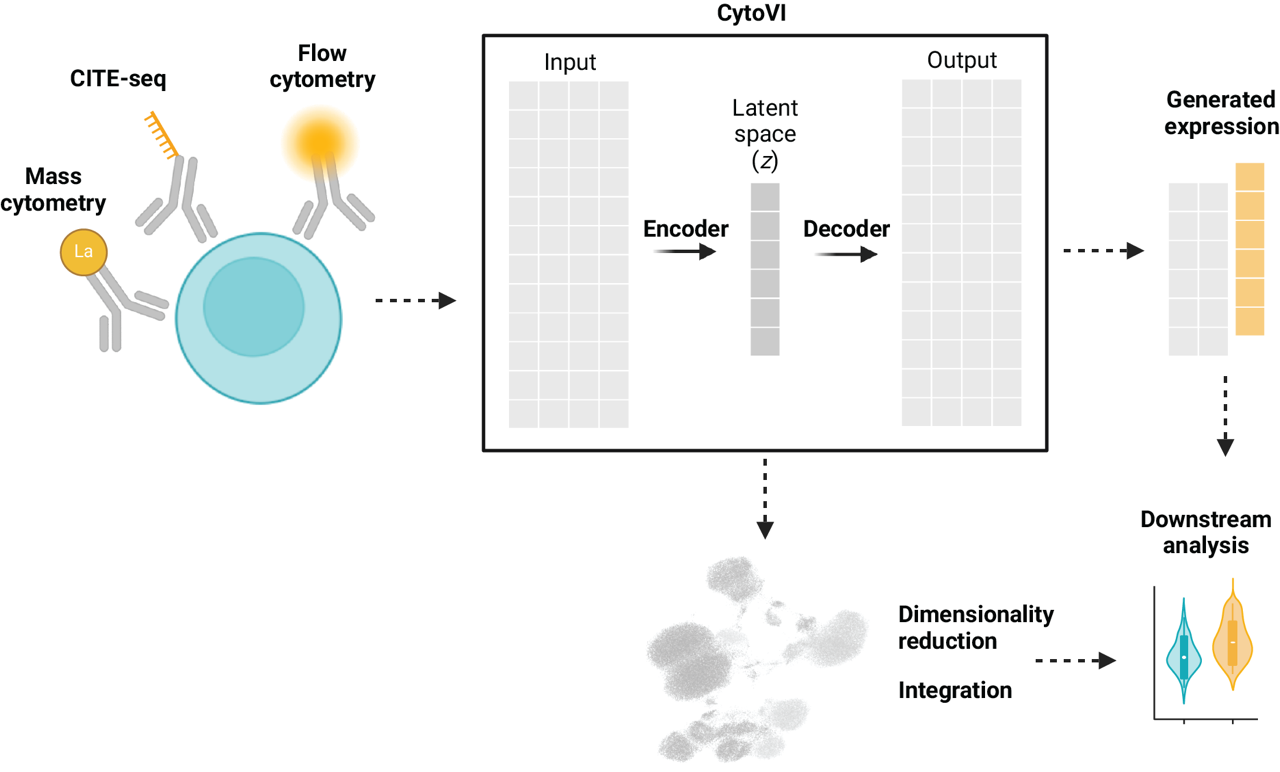
We develop generative AI models for antibody-based single-cell technologies such as flow cytometry and CITE-seq to enable robust, scalable, and clinically relevant immune profiling in oncology and hematology. These models reduce technical variability, harmonize data across panels and instruments, and increase assay dimensionality through marker imputation. Using large clinical cytometry datasets, we build foundation models of immune cell variation and enrich them with single-cell genomics, morphology, and protein colocalization data to improve disease insight, classification, and longitudinal monitoring.
We also apply spatiotemporal single-cell genomics to study how immune cells infiltrate tumors, interact within tissue niches, and become dysregulated over time. This allows us to reconstruct immune cell state trajectories and interaction networks across space and time, revealing mechanisms of immune escape, therapy resistance, and treatment failure. Together, these approaches provide a systems-level understanding of tumor–immune ecosystems and support the rational design of improved immunotherapies.
Dr. Florian Ingelfinger
Young Investigator Group Leader – partner site Freiburg
Medical Center – University of Freiburg
Ingelfinger Laboratory for Generative Single Cell Immunology