01/07/2026
Print PageGeneNovate® Finale 2026: Award for Entrepreneurial Thinking in the Field of Gene- and Cell-Based Therapies
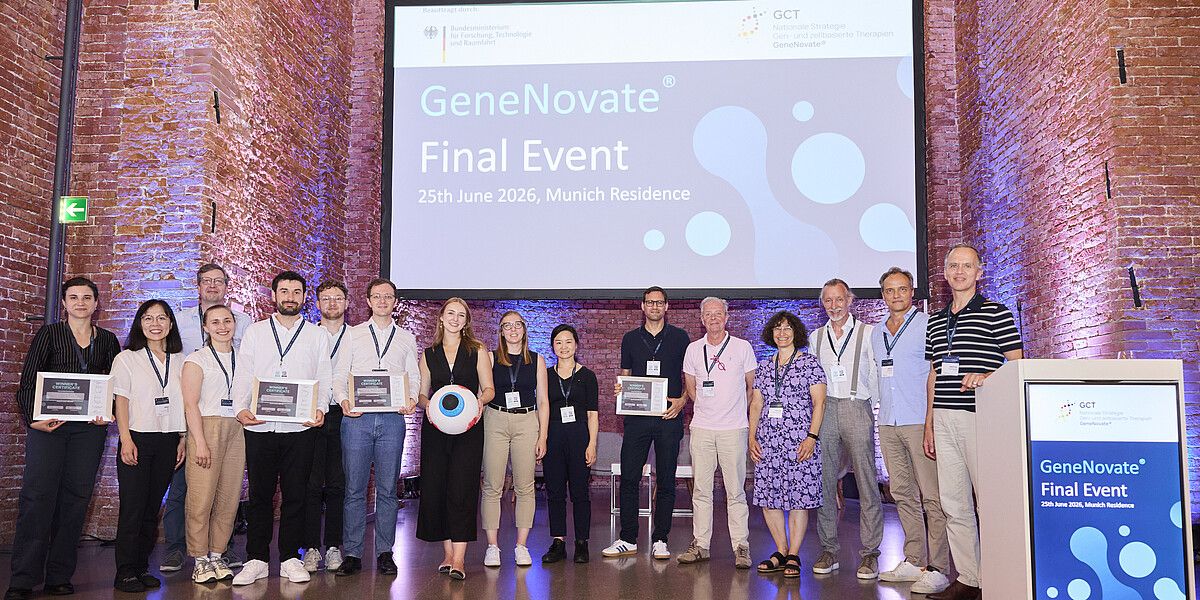
In the Bavarian capital, 25 selected teams from across Germany—who had advanced from the regional preliminary rounds (featuring a total of 45 teams)—gathered to present their ideas to a jury of experts consisting of business angels, venture capital (VC) investors, and experienced entrepreneurs. This year’s teams impressed the jury with promising approaches that offer potential for the future of healthcare. The range of projects spanned from innovative CAR-T cell therapies and novel antibody-drug conjugates (ADCs) to AI-powered platform technologies for gene editing and personalized drug manufacturing.
The jury selected four winning teams:
- MACULA PATCH / GeneNovate® Region East / Personalized cell therapy for the treatment of vision loss caused by the loss of light-sensitive cells in the eye.
- Next-PA / GeneNovate® Region North Rhine-Westphalia / Development of a fully human monoclonal antibody against the pathogen Pseudomonas aeruginosa, which is responsible for severe hospital-acquired infections with high morbidity and mortality rates.
- ReRetina / GeneNovate® Region North Rhine-Westphalia / Cell therapy to restore vision in people with age-related macular degeneration, one of the world’s most common causes of blindness.
- ZELF / GeneNovate® Region Berlin / ZELF is an approach aimed at preserving cell functionality throughout the entire manufacturing process of therapeutic cells. The goal is to enhance the therapeutic efficacy of cell therapies.
Unlocking the potential in the fields of gene and cell therapies, biotech, and medtech
Gene- and cell-based therapies (GCT) target the very source of many diseases: genes and cells. While conventional medications typically only alleviate symptoms, these new approaches aim to address the actual cause of a disease. This opens up new treatment options for people with severe or rare diseases for which no suitable therapy has yet been available. New prospects are also emerging for widespread diseases such as diabetes, cardiovascular diseases, and cancer. These technologies also offer significant opportunities for research, the economy, and healthcare in Germany.
Despite the high level of scientific excellence in the field of GCT, Germany has so far had only limited success in translating research findings into successful startups and clinical applications. Scientists and physicians, in particular, often possess outstanding technical expertise but have limited access to entrepreneurial know-how, business networks, and financing opportunities. At the same time, the requirements for developing GCT are particularly high: long development times, complex regulatory frameworks, and significant capital requirements pose major hurdles for startups.
As a nationwide entrepreneurship program, GeneNovate® supports scientists and medical professionals in realizing their translational and entrepreneurial potential in the fields of gene and cell therapies, biotech, and medtech. The program not only teaches the fundamentals of entrepreneurship but also specifically promotes interdisciplinary knowledge transfer and connects participants with experts from research, clinical practice, industry, regulatory bodies, and the financial sector. Approximately 200 researchers and medical professionals from across Germany participated in this year’s GeneNovate® Entrepreneurship Program. In 18 training and mentoring modules, participants further developed their ideas and prepared them for potential translation into practical applications as well as for the launch of startups.
The program is coordinated by the National Network Office GCT Germany in collaboration with representatives from the currently nine German regional hubs. Across all nine regions, more than 50 institutions participate in the GeneNovate® program.
Since its founding in 2024, the program has grown significantly and will be expanded to additional locations in 2027. In addition to the GeneNovate® Entrepreneurship Program, which focuses on early-stage academic projects, the GeneNovate® Investors’ Day specifically brings established startups together with potential investors to support promising developments on their path toward clinical application.
Bavaria’s Minister of Health, Judith Gerlach, emphasized: “Bavaria has been pursuing an innovation-oriented regional development policy for over 30 years. To ensure that innovations in the healthcare sector reach patients quickly and safely, we are building bridges between university teams and startups on one side and policymakers and healthcare providers on the other. One such bridge is the TUM master’s program ‘Healthcare Innovation Program.’ It takes an interdisciplinary approach, combining medical knowledge, IT expertise, and entrepreneurial skills. In the program, students tackle real-world challenges from everyday clinical practice. We create the framework to ensure that innovations do not remain in the lab, but instead make their way into healthcare in a sustainable manner and for the benefit of people!”
Prof. Dr. Christopher Baum, spokesperson for the National Strategy for Gene- and Cell-Based Therapies, as well as Chair of the BIH Board of Directors and Director of the Translational Research Division at Charité – Universitätsmedizin Berlin: “The GeneNovate Entrepreneurship Program specifically promotes a product-oriented and entrepreneurial mindset in science. Particularly in the field of gene and cell therapies, it is crucial that researchers learn early on to consider innovations from the perspective of application and implementation. This combination of scientific excellence, expertise in product design, and entrepreneurial thinking is essential for bringing new therapeutic approaches to patients more quickly and sustainably.”
Dr. Elke Luger, Director of the National Network Office for Gene and Cell Therapies and Co-Director of the GeneNovate® program: “With GeneNovate, we are creating a resilient network based on trust, in which stakeholders support one another and break new ground together. This form of collaboration across institutional and regional boundaries is crucial for accelerating innovation in gene and cell therapy. The fact that this network is also embedded in European structures further strengthens its impact and lays the foundation for sustainable progress throughout the entire innovation ecosystem.”
Dr. Ingo Schroeter, Co-Director of the GeneNovate® program: “I am particularly pleased that GeneNovate did not start out as a hierarchical structure, but rather grew organically from the ground up as a collaboration among many strong locations. That is where its strength lies. Given the complexity of gene- and cell-based precision medicine, such collaboration can provide decisive impetus for innovation and create global competitive advantages. Special thanks go to the network of over 100 experienced experts and approximately 50 mentors who support the participants and teams with great passion.”
SOURCE: BIH